

In Memoriam — Maurice Pagel (1947–2026)
It is with deep sadness that I learned of the passing of Professor Maurice Pagel, Emeritus Professor at University Paris-Sud (Orsay) and one of the key figures in the development of the Society for Geology Applied to Mineral Deposits (SGA).
Maurice Pagel was born on April 24, 1947, in Toul, France. After graduating from the University of Nancy in 1975, he briefly worked as an engineer in uranium exploration for the Mokta Company before joining the CNRS in 1976, first at the Centre de Recherches Pétrographiques et Géochimiques (CRPG) and, from 1979, at the newly created Centre de Recherches sur la Géologie de l'Uranium (CREGU) in Vandœuvre-lès-Nancy, where he served as team director until 1997. He received his doctoral degree in 1981 from the Institut National Polytechnique de Lorraine. In 1997 he was appointed Professor at the University of Paris-Sud at Orsay, where he chaired the Department of Earth Sciences from 2004 to 2009, was promoted to Professor of Exceptional Class in 2009, and became Emeritus Professor upon his retirement in 2012.
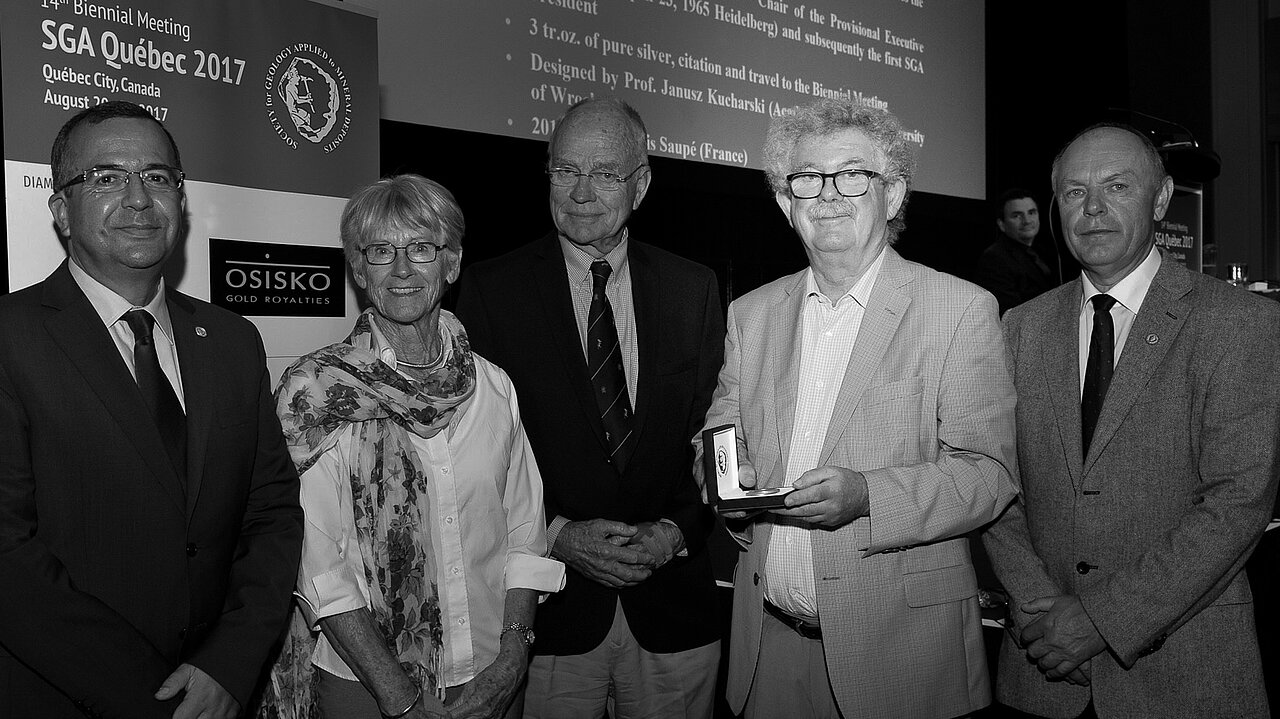
Maurice devoted his career to the study of ore deposits, focusing on the mechanisms and timing of ore formation and on the development of mineralogical and geochemical tools to better understand and date the processes responsible for anomalous concentrations of metals and fluids — geological resources in the broadest sense. His early work with Bernard Poty and Simon Sheppard on the Pine Creek Geosyncline remains a landmark in demonstrating the power of combining fluid inclusion and isotopic studies to decipher ore-forming processes. He also played an active part in the emergence of CREGU, a unique and pioneering laboratory linking academic research with the nuclear industry. His scientific interests extended far beyond economic geology: diagenesis and quartz cementation studied by cathodoluminescence, fission tracks and paleohydrology of sedimentary basins, petroleum migration through hydrocarbon-bearing inclusions, fluorite deposits, U-Th-REE accessory minerals, and natural analogues for radioactive waste disposal. He co-authored the reference book L'uranium (PUF, 1992), edited Bassins sédimentaires — Les marqueurs de leur histoire thermique (EDP Sciences) and co-edited Cathodoluminescence in Geosciences(Springer, 2000). He directed or co-directed some 35 PhD theses, was responsible for more than 60 research contracts with national institutions, the EU, and oil and mining companies, reviewed for 29 scientific journals including Mineralium Deposita, Ore Geology Reviews and Economic Geology, and organized some 35 national and international scientific meetings. Among his many honours were the Braconnot Prize of the Stanislas Academy (1982), SGA Honorary Membership (1999), a scientific meeting organized in his honour by the French Sedimentological Association (2014), and, crowning a lifelong contribution, the prestigious SGA-KGHM Krol Medal in 2017.
Maurice Pagel was one of the key persons in the development of the SGA. Elected Executive Secretary in 1989, succeeding F. Saupé (the first recipient of the SGA-KGHM Krol Medal), he served in this position until 1997. In 1991 he organized the 25th Anniversary Meeting of the Society on "Source, Transport and Deposition of Metals" in Nancy, thereby launching the tradition of the SGA Biennial Meetings. Over the following years he contributed to the logistics and co-organization of the Biennial Meetings in Granada (1993), Prague (1995), Turku (1997) and London (1999). Together with David Ricard, he established the Society's enduring relationship with Springer, and collaborated closely with David Leach on the international development of the SGA.
Maurice was also, above all, a teacher and a mentor. Throughout his career — from Nancy to the GEOPS laboratory in Paris-Saclay — he trained and inspired generations of students and researchers in research about geological resources, and was deeply committed to the transmission of knowledge and to public outreach, most recently leading a project for a mineralogy museum in Orsay. He was a demanding mentor: he asked much of his students because science, for him, allowed no compromise. Those who worked with him, whatever the difficulties, came away with standards that stayed with them throughout their careers. I still remember him promising me, at the outset of my PhD, fieldwork around the world — my thesis site finally ended up no more than 80 km from his office. Yet behind these twists and turns lay a supervisor who never let a problem go unresolved, and who pushed me further than I thought I could go.
The SGA has lost one of its founding figures. He will be remembered with gratitude and affection by all those whose scientific lives he shaped.
Jacques Pironon Emeritus Research Director at CNRS, GeoRessources Laboratory, Université de Lorraine, Nancy, France
Citation: Maurice Pagel - SGA KGHM Krol Medal
The following citation was prepared and presented by J. Pašava (SGA Executive Secretary):
Mr. Chairman, Ladies and Gentlemen,
I am honored to present the citation of Dr. Maurice PAGEL – the second recipient of the very prestigious SGA-KGHM KROL MEDAL. Maurice Pagel was born on April 24, 1947 in Toul, France. After elementary and high school education in Toul, he joined the University of Nancy from which he graduated in 1975. He received his Ph.D. in 1981 from the Polytechnic National Institute of Lorraine where he successfully defended the thesis “U and Th distribution and concentration factors in some granites of the European Hercynian Chain”. After the University studies he shortly served as Engineer at the Mokta Company (focused on U-prospecting). In 1976 he joined the Petrography and Geochemistry Research Centre in Vandoeuvre les Nancy (CNRS) and in 1979 he changed for the Uranium Geology Research Centre where he served as a team director from 1987 to 1997. In 1997 he left CNRS and became Professor and in 2009 Professor of Exceptional Level (Classe Exceptionnelle) at the University Paris-South at Orsay where he acted as Chair of the Departmenf of Earth Sciences (2004-2009). He retired from the University in 2012 and received the status of Emeritus Professor.
His scientific interests were fluid mineral interactions in sediments (diagenesis), thermal history of sedimentary basins, genesis of unconformity-type uranium deposits and sediment-hosted U- deposits, genesis of fluorite deposits, U-Th-REE accessory minerals in rocks and uranium mill tailings and nuclear wastes storage. He directed or co-directed some 35 PhD thesis and was responsible for 60 research contracts with national institutions, the EU and also Oil and Mining Companies. He reviewed papers for 29 scientific journals including Mineralium Deposita, Ore Geology Reviews and Economic Geology. He also organized about 35 national and/or international scientific meetings.
Recently, he was responsible for two national research programs. Firstly, a research consortium between CNRS and ANDRA on “Present and past transfer in a sedimentary aquifer/aquitard system”, he was a Gust Editor of a Marine and Petroleum Geology” (Volume involving 56 authors). Secondly, since 2007, he has been co-Director of a CNRS-AREVA-CEA program on Uranium Resources. He has edited several books of which the best known book on Cathodoluminescence in Geosciences in 2000.
Maurice Pagel is also recipient of numerous honors and awards (e.g., Braco not Prize from the Stanislas Academy in 1982, SGA Honorary Membership in 1999, Meeting organized in honour of M. Pagel by the French Sedimentological Association in 2014 and others).
Maurice Pagel is one of the key persons who played an important role in the development of the SGA. In 1989 he was nominated and elected as the SGA Executive Secretary, replacing F. Saupé – the first recipient of the SGA-KGHM Krol Medal (2015, Nancy). M. Pagel served in this position until 1997. In 1991, he organized the 25 years SGA Anniversary Meeting on ”Source, transport and deposition of metals” (Nancy, August 30 September 3, 1991) and thus launched the tradition of SGA Biennial Meetings. Since 1991 M. Pagel was actively involved not only in routine SGA administration but also in the logistical support and/or co-organization of the 2nd, SGA Biennial Meeting (1993 - Granada, Spain), the 3rd SGA Biennial Meeting (1995 - Prague, Czech Republic), the 4th SGA Biennial Meeting (1997 - Turku, Finland) and the 5th SGA Biennial Meeting (1999 - London, UK). During his term he was jointly with David Ricard (Chief Editor, MD) also involved in establishing new relationships with Springer Publishing House and actively collaborated with David Leach on further international development of the Society.
Many of us have had the pleasure of interacting and collaborating scientifically with Dr. Pagel. Although now retired, he remains interested in mineral deposits. On behalf of SGA, I would like to congratulate Dr. Pagel on this and his other successes and we wish him all the best.